
Last year, we quietly co-led a seed investment in Relay Commerce, a platform that acquires and grows e-commerce SaaS tools to automate revenue generation for SMB merchants.
Undoubtedly, the Covid-19 pandemic accelerated the secular shift to e-commerce that has dominated the retail space for the past two decades. In the United States, social distancing requirements and increased digital media consumption catapulted e-commerce sales to a record $1.03 trillion in 2022, the first time in the nation’s history.
For the most part, this trend is simply a continuation of what we have seen in the 2000s and the 2010s. But what’s most compelling is the changing power dynamics within the e-commerce landscape. In the two decades leading up to Covid, large platforms — from general retailers such as Amazon and Wal-Mart, to vertical marketplaces like Wayfair and Chewy — capitalized on consumers’ newly-found openness to online shopping, taking market share from brick-and-mortar channels. But since 2020, we have seen a new entrant in digital retail: small- and medium-sized businesses. Faced with lockdowns, SMBs — which had historically shied away from e-commerce — started embarking on a digital transformation journey, setting up digital storefronts and modernizing their marketing, billing, and analytics workflows.
The pandemic was a turning point for SMBs and their relationship with e-commerce. Over the past three years, SMBs’ growth in e-commerce has far outpaced that of Enterprises, as demonstrated by the growth of Shopify’s GMV over the past three years.
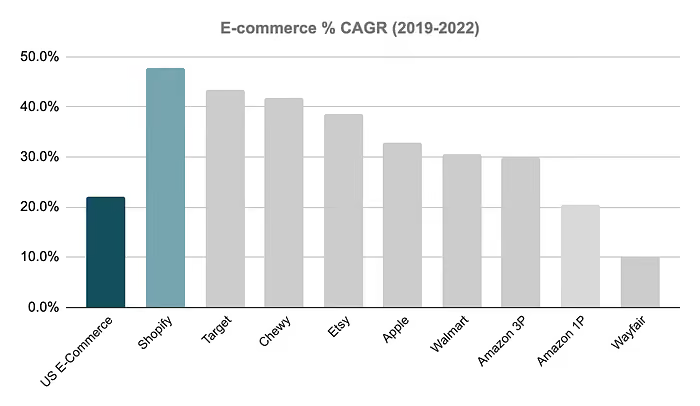
So far in 2023, SMBs continue to gain market share, with Shopify’s GMV growing at nearly 15% year-over-year, even while the U.S. e-commerce sales growth has slowed down to 8%. Interestingly, several enterprises — including Wayfair and Target — have seen a decline in digital sales.
We believe SMBs’ share in the digital landscape will continue to grow, which highlights the need for better e-commerce enablement tools designed specifically for SMBs. Over the past few years, we have seen a proliferation of SaaS solutions for small merchants selling on platforms such as Shopify, WooCommerce and Amazon. However, the rapid evolution of the e-commerce tech stack has resulted in a hyper-fragmented space, where the quality of SaaS solutions is highly variable. This patchwork of apps often lacks end-to-end integrations and distracts SMBs from their main business goal: revenue generation.