We’re excited to announce our investment in Barnwell Bio, a precision animal health intelligence company applying metagenomic sequencing to the global food supply chain. Founded by Michael Rhys, Casey McGinley and Jake Byrnes, who previously build the nation’s first COVID-19 wastewater monitoring infrastructure. They’re now applying that same biosurveillance approach to livestock market, starting with the poultry industry, helping producers detect disease threats before they become crises.
The global poultry market is worth $315B and sits at the intersection of several critical systems that impact all of us. When disease strikes a poultry operation, the effects ripple through feed integrators, commodity markets, food prices, and ultimately to consumers at the grocery store.
The ongoing bird flu crisis demonstrates this interconnection. The U.S. economy has lost over $14 billion to avian influenza in 2024–2025 alone. These aren’t just numbers on a balance sheet. They represent higher egg prices, disrupted supply chains, and culled flocks.
But the challenge extends beyond economics. Our food supply chain is a matter of national security. Disease surveillance in livestock isn’t just about farm profitability. It’s about ensuring stable food supplies, preventing zoonotic disease transmission to humans, and maintaining the infrastructure that feeds our population.
Climate change is accelerating these challenges. Shifting weather patterns are creating new disease vectors and expanding the range of pathogens that threaten livestock. What used to be regional problems are becoming global ones. The increasing frequency of disease outbreaks isn’t a coincidence. It’s a predictable consequence of environmental changes that favor pathogen spread.
This creates costs that cascade through the entire ecosystem. Farmers face losses from sick or culled animals. Feed suppliers lose customers. Processors see reduced capacity. Commodity traders face volatility. Consumers pay more at the store. Everyone in the chain absorbs some portion of the damage.
Better biosurveillance can change this equation. Early detection means early intervention. Early intervention means smaller outbreaks. Smaller outbreaks mean lower costs across the board.
Metagenomic sequencing is the technology that makes Barnwell’s approach possible. Unlike traditional diagnostic tests that look for one specific pathogen, metagenomic sequencing captures all the genetic material in a sample. You get a complete picture of the microbial ecosystem.
In 2001, sequencing a human genome cost over $100 million. By 2014, Illumina brought that down to $1,000 with the HiSeqX Ten. In 2022, they introduced NovaSeq X, targeting $200 per genome. Companies like Ultima Genomics are pushing toward $100 per genome. A 99.9% cost reduction in two decades is the cost curve decline that we look for, much like software, to unleash a new wave of innovation.
The cost decline came from several breakthroughs. Next-generation sequencing platforms replaced Sanger sequencing. Competition among equipment manufacturers drove innovation. Companies like Illumina, Oxford Nanopore, and others kept pushing boundaries. Reagent costs fell with scale. Computational tools improved, making analysis faster and cheaper.
Here’s what the cost curve looks like:
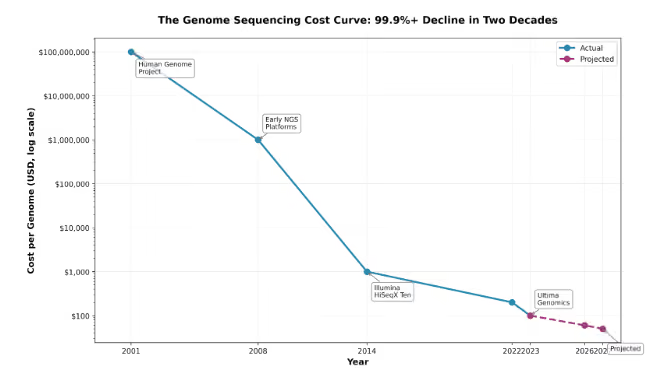
The cost of sequencing a human genome has fallen from $100 million in 2001 to under $100 today, with projections suggesting sub-$50 costs by 2027. This 99.9%+ cost reduction over two decades has unlocked entirely new applications, from precision medicine to environmental biosurveillance.
This same pattern has driven every major technology platform. Cloud computing costs dropped exponentially, enabling the software-as-a-service revolution. Solar panel costs fell 90%, making renewable energy economically viable. DNA synthesis costs declined 1000x, creating the synthetic biology industry.
When fundamental technology costs drop this much, new applications become possible. Things that were too expensive to consider suddenly make economic sense. Markets that didn’t exist get created.
This cost curve is why Barnwell Bio can exist today and couldn’t have existed ten years ago. Running metagenomic sequencing on environmental samples from barns would have been prohibitively expensive. The economics didn’t work.
Now they do. Barnwell can sequence the complete microbial ecosystem of a poultry barn, process hundreds of thousands of data points, and deliver actionable insights to producers at a price point that makes sense for their operations.
The technology isn’t just cheaper. It’s better. Modern sequencing platforms generate more data, with higher accuracy, in less time. The bioinformatics tools to analyze that data have improved dramatically. Machine learning models can identify patterns that would be invisible to traditional analysis.
This is the same pattern we saw with cloud computing and SaaS. When Amazon launched AWS, it wasn’t just about renting servers. It was about making computing infrastructure so cheap and accessible that new business models became viable. Companies that couldn’t afford their own data centers could now scale globally. Software startups could launch without capital expenditure.
The sequencing cost curve creates a similar shift. Barnwell can offer continuous environmental monitoring instead of point-in-time testing. They can detect threats weeks before clinical symptoms appear. They can give producers visibility into the microbial ecosystem that shapes their operation’s health and performance.
The team’s experience scaling national wastewater monitoring for COVID-19 gave them the operational playbook. They know how to collect samples, process them at scale, and deliver insights that stakeholders can act on. They learned what works in biosurveillance when speed and accuracy both matter.
Now they’re applying that knowledge to an industry that desperately needs it. Poultry producers are caught between regulatory pressure to eliminate routine antibiotics and increasing disease threats. Barnwell’s platform gives them a tool to maintain biosecurity without sacrificing productivity.